
Florida’s roads remain among the busiest in the nation. Between year-round tourism, steady population growth, and high-volume highways like I-4 and I-95, traffic accidents continue to be a serious safety issue statewide.
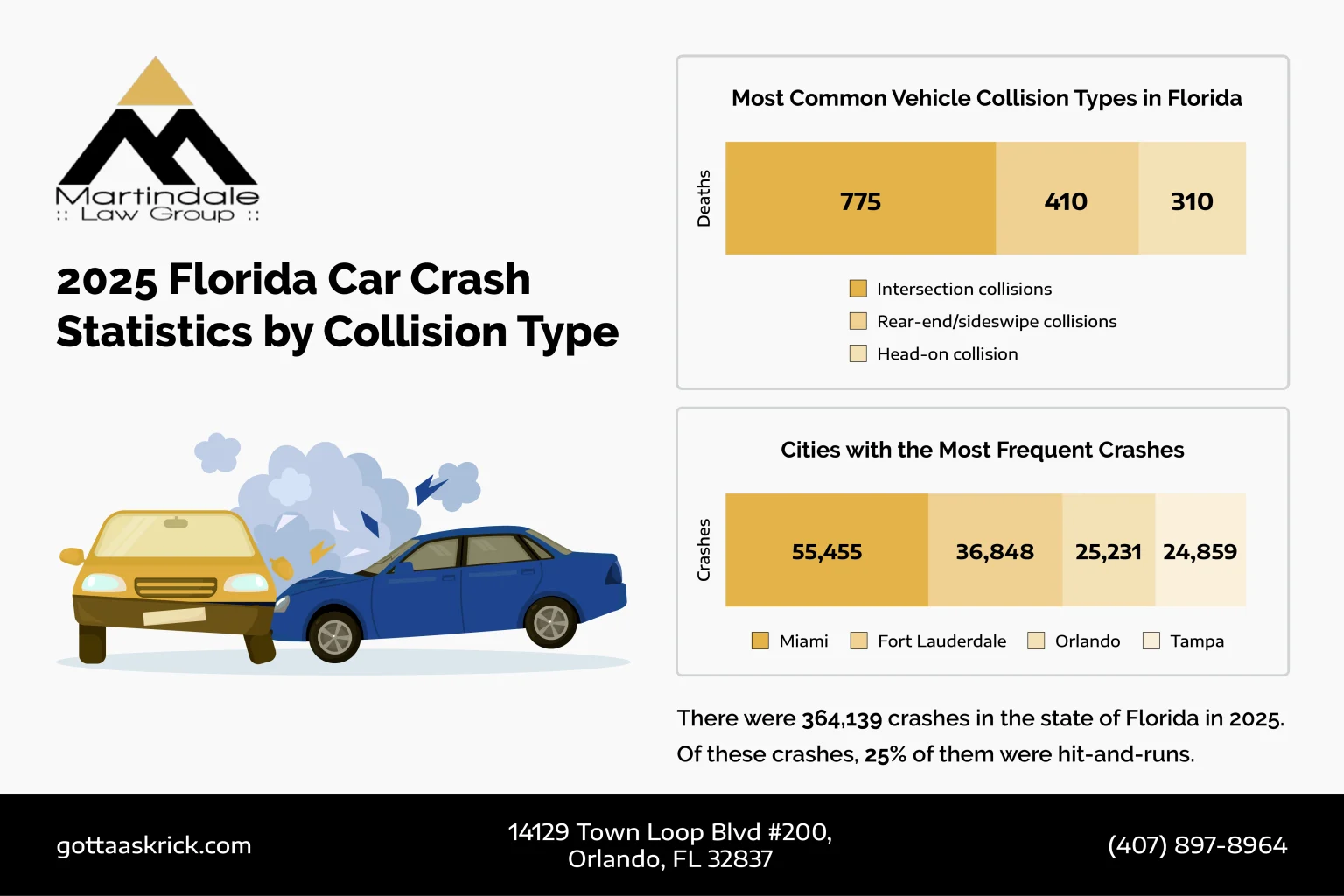
In 2025, there were 364,139 total crashes in the state of Florida. Data from the Florida Highway Safety and Motor Vehicles (FLHSMV), along with national agencies such as the National Highway Traffic Safety Administration (NHTSA) and the Insurance Institute for Highway Safety (IIHS), helps identify where and how these crashes occur.
Here’s a quick look at Florida car accident statistics courtesy of our team at Martindale Law Group.
Statewide data shows that most crashes are not random events but are linked to preventable behaviors and roadway conditions. The sections below break down the leading causes of Florida car accidents in 2025 and how these factors continue to impact drivers across the state.
According to car accident statistics in Florida, distracted driving remains one of the leading contributors to crashes. FLHSMV data consistently shows that inattention behind the wheel plays a role in countless reported collisions each year. Even brief lapses in focus can have severe consequences, especially in congested urban areas like Orlando, Tampa, and Miami.
Driving under the influence of alcohol or drugs continues to be a major factor in serious Florida crashes. Alcohol-related crashes are especially common during holidays, spring break, and late-night hours, when traffic enforcement and emergency response activity typically increase
Florida’s tourism-driven nightlife corridors and entertainment districts contribute to elevated DUI risk in cities such as Orlando, Miami, and Tampa.
Behaviors such as tailgating, unsafe lane changes, and road rage incidents often leave drivers little time to react, leading to multi-vehicle crashes with serious consequences.
State and federal crash data show that excessive speed increases both the likelihood of a collision and the severity of resulting injuries. High-speed roadways, including interstates and major freight corridors, see a disproportionate number of deadly crashes involving speeding or aggressive maneuvers.
Florida’s climate presents unique driving challenges. Heavy rainfall, frequent thunderstorms, and seasonal hurricane activity can quickly reduce visibility and create slick road surfaces. Sudden downpours are particularly hazardous on high-speed highways and in areas with heavy traffic volume.
Drivers who fail to slow down or adjust for weather conditions face an increased risk of losing control, especially during peak travel periods.
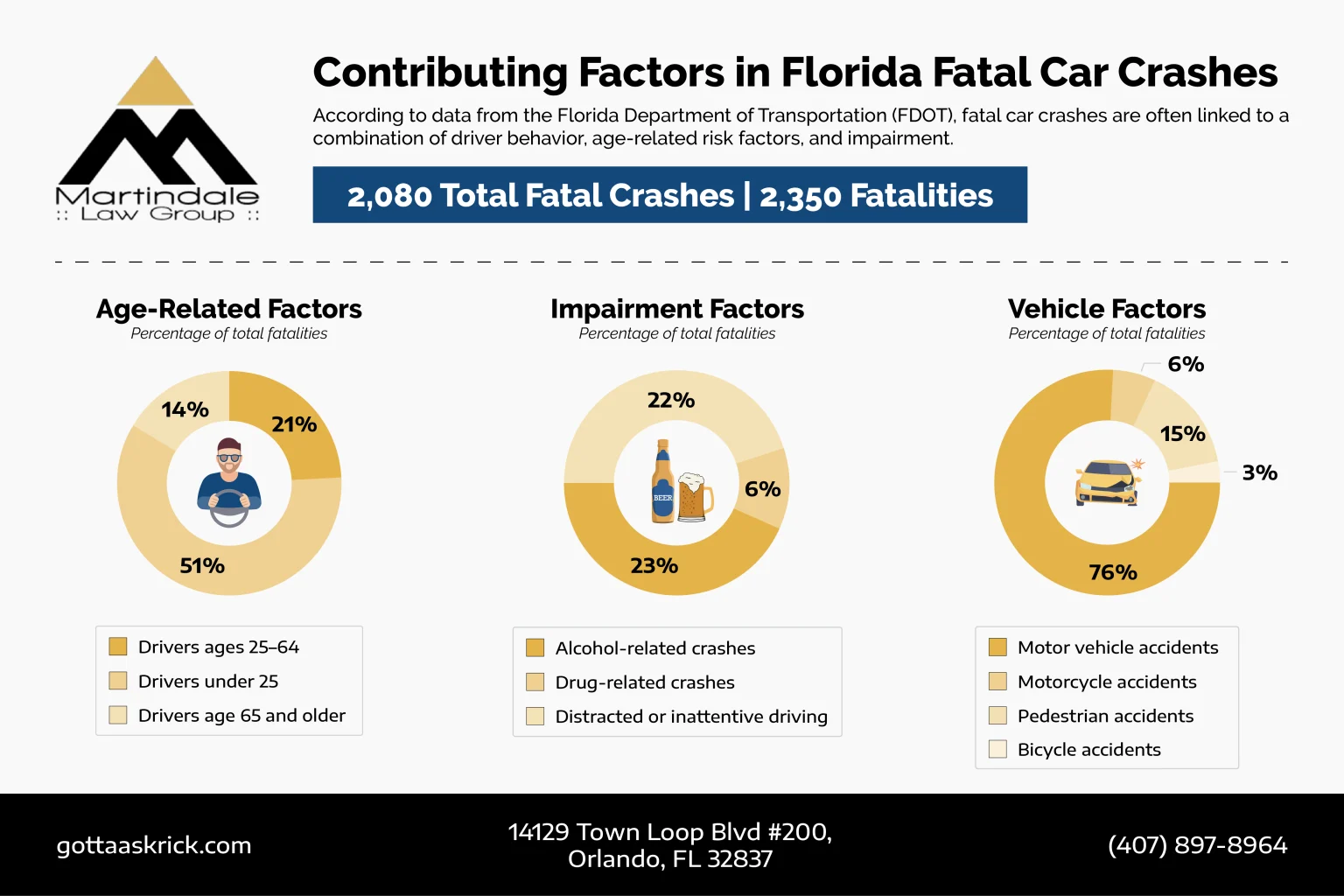
Even as vehicle safety improves, Florida continues to report a high number of traffic-related deaths and serious injuries each year. According to Florida car accident statistics, there were 2,889 fatalities and 237,201 injuries from vehicle accidents in 2025.
Serious crashes often lead to long-term consequences for victims and families, including extended medical treatment, rehabilitation, and lost income. This crash data is frequently used in Florida car accident claims to push for compensation that helps victims recover.
Crash data consistently shows that certain road users face a higher risk of fatal injury in Florida. In 2025, there were 570 motorcycle fatalities, 196 bicycle fatalities, and 606 pedestrian fatalities.
Statistically, passenger vehicles saw the highest number of fatalities due to multiple people in the vehicle. However, the data still shows that motorcyclists and pedestrians are at the greatest risk of severe injuries and even death.
Non-fatal crashes still carry significant consequences. Florida injury data shows a high incidence of traumatic brain injuries, spinal damage, and orthopedic injuries, many of which require long-term care.
Recovery can involve surgeries, physical therapy, and ongoing medical monitoring, placing a lasting financial and emotional burden on victims. Even with proper compensation, victims can still have long-lasting symptoms after an accident.
Major metro areas consistently report higher crash volumes due to traffic density, tourism, and commuter congestion. Cities such as Miami, Orlando, and Tampa see elevated collision rates, particularly along highways, downtown corridors, and near entertainment districts.
In 2025, there were:
Tourist-heavy zones present added risk. Rideshare traffic, unfamiliar drivers, and late-night activity contribute to increased crashes in areas with people from out-of-state. Hit-and-run crashes are also more common in dense urban areas, often leaving injured victims without immediate answers or accountability.
Urban crashes often involve lower speeds but higher vehicle volume, increasing the likelihood of multi-vehicle collisions and pedestrian injuries. Rural crashes, while less frequent, are more likely to be fatal due to higher speeds, limited lighting, and longer emergency response times.
Florida experiences noticeable crash spikes during spring break, summer travel months, and major holidays. Hurricane season can also increase accident risk when heavy rain, debris, and evacuation traffic combine to create hazardous driving conditions.
Certain groups face a higher likelihood of serious injury or death on Florida roads:
Florida continues to rank in the top 10 nationally for pedestrian fatalities, underscoring the need for improved roadway safety and awareness.
Florida’s roadways support a wide mix of passenger vehicles, motorcycles, commercial trucks, and vulnerable road users, each with distinct risk patterns. Crash data shows that the type of vehicle involved plays a major role in injury severity and fatal outcomes.
Passenger cars account for the majority of reported crashes in Florida, largely due to sheer volume. Most of these collisions involve distracted driving, congestion-related rear-end crashes, and unsafe lane changes, especially in metro areas.
While many passenger vehicle crashes result in minor injuries, high-speed impacts significantly increase the risk of serious harm.
Motorcyclists face one of the highest fatality rates per mile traveled in Florida. Limited physical protection, speeding, and impaired driving can contribute to severe outcomes. In 2025, there were 8,861 motorcycle accidents in the state, resulting in over 500 fatalities.
Florida’s warm climate and long riding season also increase overall exposure, placing motorcyclists at greater risk year-round.
Crashes involving semi-trucks and commercial vehicles are less frequent but often far more severe. These collisions commonly occur on interstates and freight corridors and may involve underride crashes, jackknifing, or multi-vehicle pileups.
Victims in these cases often suffer catastrophic injuries due to the size of commercial vehicles, and this risk only increases on busy interstates or during rush hour.
Florida consistently ranks among the most dangerous states for pedestrians and cyclists. Urban streets with high traffic volume, limited crossings, and poor lighting contribute to elevated fatality rates. These crashes frequently result in severe or fatal injuries due to the lack of physical protection.
In 2025, there were 10,684 pedestrian accidents and 9,847 bicycle accidents, resulting in over 700 total fatalities. These victims are the most at risk of serious, lifelong injuries and complications.
When compared with national data, Florida continues to rank near the top for total traffic crashes and fatalities. According to IIHS and NHTSA, Florida consistently reports one of the highest numbers of traffic-related deaths nationwide, largely due to population size and tourism.
Florida also stands out in several specific categories. The state regularly ranks among the highest for pedestrian fatalities, particularly in urban areas, and reports elevated motorcycle deaths compared to national averages.
Understanding Florida car accident statistics from 2025 provides insight into how and where crashes happen, but the data alone does not protect your rights after a serious collision. When accidents involve negligence, such as impaired driving, speeding, or hit-and-run behavior, injured victims may be entitled to compensation for medical costs and long-term care.
At Martindale Law Group, our team represents car accident victims throughout Orlando and the surrounding areas. We offer free consultations and focus on helping clients navigate Florida’s injury laws with clarity and confidence.
If you or a loved one has been injured in a Florida car accident, get in touch with one of our experienced attorneys who can help you understand your options and next steps. We work on a contingency fee basis, meaning you don’t pay us unless we win your case.